
2027 AEDC Collection
26 April to 30 July 2027
The AEDC national collection provides valuable information about children’s development and helps schools, communities and governments support better outcomes for children.
What is the AEDC?
Understanding Children’s Development
The Australian Early Development Census (AEDC) is a national collection that measures how children are developing as they begin their first year of full-time school (Prep).
The 2027 AEDC will be the 7th national collection, taking place from 26 April to 30 July 2027.
The AEDC provides valuable information that helps schools, communities and governments support children’s learning, development and wellbeing.
The Five AEDC Developmental Domains
The AEDC measures children’s development across five key domains:
AEDC domains
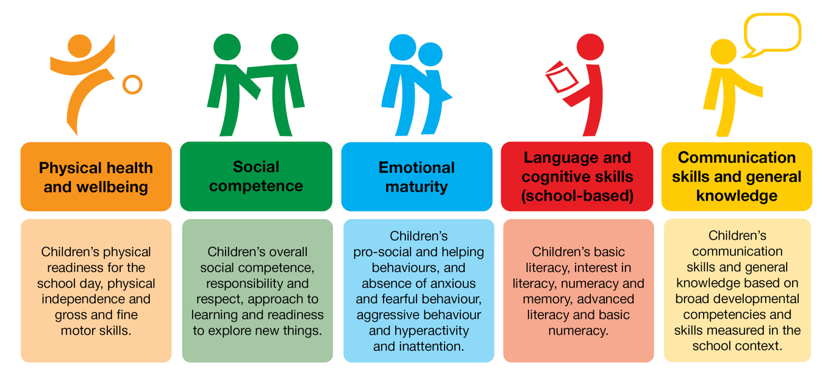
Children are identified as being developmentally:
- on track
- at risk, or
- vulnerable in each domain.
Explore each AEDC domain in more detail through the New South Wales AEDC domain videos.
Preparing for the 2027 AEDC Collection
2027 AEDC Collection
The seventh national AEDC collection will take place between 26 April and 30 July 2027.
Teachers complete the AEDC for children in their first year of full-time school, helping build a national picture of children’s development.
For Principals and Teachers
This national collection provides valuable information about children’s development and helps schools, communities and governments support better outcomes for children.
- Your leadership is essential to a successful AEDC collection. Principals guide the AEDC’s delivery in their school.
- Completing the AEDC is secure, straightforward and doesn’t require children to be present.
- Teacher relief funding is available to help cover the time and cost involved in completing the AEDC.
- Support is available to help you complete the AEDC.
- Aboriginal and Torres Strait Islander Cultural Consultants strengthen the quality of data collected for communities.
- Even if your school is small or remote, your contribution counts. AEDC data from all schools – regardless of size or type – contributes to community, state and national reporting.
- Schools for children with additional needs provide essential, otherwise unavailable data.
- You will receive a School Profile as soon as you complete the collection for your school. This means you can start using your AEDC data straight away. Your school’s AEDC Profile can help:
- Understand cohort strengths and needs
- Inform School Improvement Plans
- Strengthen transition practices
- Monitor trends over time
Further Information
- Resources for Schools
- Webinars [Yet to be recorded]
- Email aedc@decyp.tas.gov.au
AEDC for Early Childhood Educators
The AEDC gives educators a common language to identify strengths and areas for support, both within their service and across the community, to help children thrive in the early years.
This evidence can inform policy and practice in early childhood education.
The five AEDC domains show, at a community level, children’s learning and development needs.
AEDC Domains
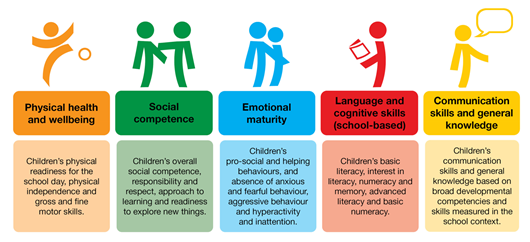
The AEDC can also provide insight into children’s future development and learning and where additional support may be beneficial.
Videos about the AEDC for ECEC
Access the resources and watch these videos to discover how AEDC data can help educators understand their ECEC’s community strengths and needs, supporting intentional planning and quality practice in ECEC services.
AEDC Professional Learning Modules
Build your confidence in understanding and using AEDC data.
The AEDC modules have been developed for educators working in early childhood education and care services.
These self-paced AEDC modules explore:
- What the AEDC is and why it matters
- Understanding developmental domains
- Accessing and interpreting AEDC data
- Program planning and responding to vulnerability
The course includes six 20-minute online modules.
Start learning by completing the Registration Form AEDC Professional Learning Modules – Fill in form
AEDC for Families
The Australian Early Development Census (AEDC) provides a snapshot of how children are developing as they start school, helping communities support children and families to thrive.
What does the AEDC measure?
The AEDC measures children’s development across five key domains:
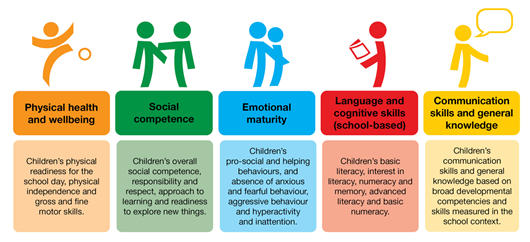
Physical health and wellbeing – Growing Strong every day
Try this:
- Walk, ride or play outside together
- Encourage healthy meals or snacks
- Practise skills like throwing, catching and climbing
Social competence – Learning to Connect
Try this:
- Play games that involve taking turns
- Encourage your child to help with simple jobs
- Model kindness and respect
Emotional maturity – Feelings and caring
Try this:
- Name emotions together
- Talk about feelings during story time
- Celebrate efforts
Language and cognitive skills (school-based) – Everyday learning counts
Try this:
- Read together every day
- Count items whilst shopping
- Play rhyming and word games
[Flip side Communication Skills and General Knowledge]
Communication skills and general knowledge – Everyday learning counts
Try this:
- Encourage imaginative play
- Explore nature together
- Cook and chat about different cultures
Does the AEDC assess my child?
- The AEDC is completed by teachers based on their observations.
- It is not a test for children.
- Individual child results are not reported.
- Data is combined and reported at community, state and national levels.
How can families support their child’s development?
- Reading together
- Playing and talking every day
- Building healthy routines
- Encouraging social and emotional skills
- Connecting with local services and supports
AEDC Reports and National Website
Download the latest AEDC reports
- 2024 AEDC National Report
- 2024 AEDC Tasmanian Report
- Visit the Australian Early Development Census website to access a range of resources for Early Childhood Education and Care services (ECEC), communities and schools.
AEDC Grants
Supporting Communities and Schools
The AEDC Tasmanian Grants provide funding for local initiatives that support children and families during the vital early years of development.
These grants are designed to build on what’s already working well in communities but also meet the needs of children with ‘developmental vulnerability’ within the local community.
Funded programs help turn AEDC data into meaningful action by:
- Supporting children’s learning, health and wellbeing
- Strengthening community‑based early years responses
- Raising awareness of the AEDC among early years professionals
- Increasing the use of AEDC data to inform planning and practice
2026-27 AEDC Grant Recipients
We are pleased to congratulate the nine organisations awarded funding through the 2026-27 AEDC Grants Program:
- Emerge Allied Health
- Windermere Primary School
- Clarendon Vale Primary School
- Siblings Australia
- Carlton Street Child Care
- Tasmanian Aboriginal Centre
- Swansea Primary School
- JRLF Herdsmans Cove Primary School
- Tasmanian Catholic Education Office
These projects will support children, families and communities across Tasmania over the next 12 months.
Congratulations to all recipients and thank you for your commitment to supporting Tasmania’s children and families.
AEDC National Website
Find out more about the AEDC at the Australian Government AEDC website.
For further information about the AEDC visit Home | Australian Early Development Census (AEDC)
Contact Us
Forfurther information about the AEDC contact the AEDC State and Territory Coordinator ph: 61655793 or email: aedc@decyp.tas.gov.au
For information on community profiles and resources about the AEDC visit the Home | Australian Early Development Census (AEDC)